Sunday, September 7, 2014
Introduction
Tea is one of the most widely consumed drinks in the world, with a rich history stretching back centuries. It is used in many different traditions spanning many continents, and was the cause of one of the largest acts of industrial espionage in history. In an endeavor to gain a more complete understanding of this popular commodity and how it has helped shape history, I will be reading Sarah Rose's For All the Tea in China: How England Stole the World's Favorite Drink and Changed History. I will be looking at what made tea such a valuable substance and how such a seemingly trivial and straightforward matter as the trading of leaves could become so convoluted.

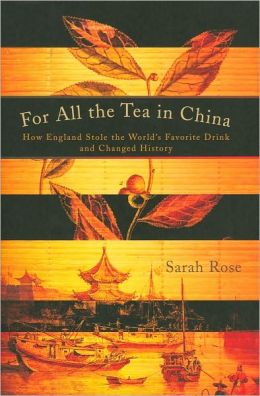
Book #1: For All the Tea in China: How England Stole the World's Favorite Drink and Changed History by Sarah Rose
Product Details:
- Paperback: 272 pages
- Publisher: Penguin Books (February 22, 2011)
- Language: English
- ISBN-10: 0143118749
- ISBN-13: 978-0143118749
Professional Review from Booklist: Through the adventures of Robert Fortune, a nineteenth-century plant hunter, the reader learns a delicious brew of information on the history of tea cultivation and consumption in the Western world. Rose’s book is certain to draw the attention of history buffs, foodies, avid travel-literature fans, followers of popular science, and perhaps even business-interest book consumers as she reconstructs what she posits as the “greatest theft of trade secrets in the history of mankind.” Tea was grown in China. Great Britain wanted tea. But trying to trade with the Celestial Empire was like pulling teeth. So the East India Company sent hunter Fortune, undercover (dressed in mandarin robes), to penetrate the depths of China and surreptitiously gather—steal, in other words—seeds and young plants and send them to India, where they would flourish in soil that was part of the British Empire. The author’s bold conclusion to this remarkably riveting tale is that Fortune’s “actions would today be described as industrial espionage,” but nevertheless he “changeed the fate of nations.”
Customer Review from Amazon.com: This is a fascinating book on many fronts. As a story of corporate espionage, it touches on issues of trade and economics that are controversial today. The technology used to bring viable seeds and plants to India is astounding when one considers that
sailing ships were the transportation means of that era. A spotlight is put on the opium trade, an issue that still resonates. Sarah Rose writes with a lively, clear style that makes this a hard book to put down. I recommend this book to historians, tea drinkers, economists, gardeners and corporate policy makers. Brew up a cup and enjoy!
I selected this book because it seems not only to entertain the reader, but to provide him with a complete history of the commodity.

sailing ships were the transportation means of that era. A spotlight is put on the opium trade, an issue that still resonates. Sarah Rose writes with a lively, clear style that makes this a hard book to put down. I recommend this book to historians, tea drinkers, economists, gardeners and corporate policy makers. Brew up a cup and enjoy!
I selected this book because it seems not only to entertain the reader, but to provide him with a complete history of the commodity.
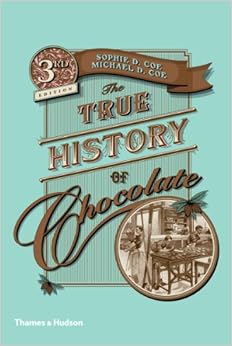
Book #2: The True History of Chocolate by Sophie D. Coe
Product Details:

- Paperback: 280 pages
- Publisher: Thames & Hudson; 3 edition (June 28, 2013)
- Language: English
- ISBN-10: 0500290687
- ISBN-13: 978-0500290682
Professional Review from Booklist: The Coes' examination of the history of the "food of the Gods" is a delight that can be enjoyed on several levels. Historians should find the interaction between economic factors and the power relations in meso-America fascinating. Anthropologists can immerse themselves in the ample information illustrating how entire cultures were shaped and modified by the expanding value of the cacao plant. Finally, those interested in food science should find the extensive descriptions of chocolate production, from growth to refinement to delivery, to be both informative and thought provoking. The Coes are well prepared to write such a definitive history; the late Sophie had both a culinary and an anthropological background, while Michael has written extensively on pre-Colombian civilizations. The result is a superbly written, charming, and surprisingly engrossing chronicle of a food and how its development has touched the lives of cultures around the world.
Customer Review from Amazon.com: Sophie and Michael Coe have written a emminently readable history of chocolate. They emphasize the origins of cacoa in the New World, and the Spanish conquerors' response to their "discovery" of cacoa. The story fascinates, and I liked how the authors presented all the options when historical records were scarce or contradictory. The text is interspersed with clarifying illustrations, some are in color. The 19th and 20th centuries are covered in brief. The
book ends with the resurgence in deluxe chocolates that use the rarer yet better tasting cacoa beans, and explains why these chocolates are so much better tasting than the supermarket candy bar. All in all, an excellent read.
Based on the reviews, this it seems that this book draws distinct connections between the discovery of cocoa and certain economic trends at the time.
Based on the reviews, this it seems that this book draws distinct connections between the discovery of cocoa and certain economic trends at the time.
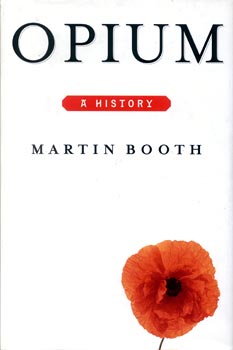
Book #3: Opium: A History by Martin Booth
Product Details:
- Paperback: 400 pages
- Publisher: St. Martin's Griffin; 1st edition (June 12, 1999)
- Language: English
- ISBN-10: 0312206674
- ISBN-13: 978-0312206673
Professional Review from Publishers Weekly: Veteran British author Booth takes us from P. somniferum to "black gold," compellingly documenting the influential role of the opiate trade throughout history. British colonizers, for example, used both legal and illicit opium production as a chief source of revenue in India, while for Dutch, British and Portuguese traders opium was a means to pacify and carve up China. The CIA's alleged drug-dealing exploitsAto finance covert operations and to bribe local leadersAare also amply documented here. Although Booth delves into the opiate-taking habits of Graham Greene, Wilde, Cocteau, Dickens, Poe and Coleridge, he doesn't romanticize drug use. While the facts can be rather dry, his comprehensive, nation-by-nation survey of international narcotics traffickingAwhich he views as a global societal disorderAmay deter potential initiates. This history of the mechanics of the heroin trade industry brings us right to the present, where the market for the drug, Booth argues, is tied up with legitimate global trade.
Customer Review from Amazon.com: Booth writes a truly fascinating and detailed history of opium's influence on the world's history, economies, and cultures. According to the author, opium has been used by man since prehistoric times. It was already under cultivation in Mesopotamia by 3400 B.C. He describes the wars that have been fought to control the opium trade, and nowadays the multi-billion dollar heroin industry. Nor does he neglect the social implications of an addicted population:
"For many addicts, heroin is favoured because, whilst allowing them to maintain full consciousness,
Customer Review from Amazon.com: Booth writes a truly fascinating and detailed history of opium's influence on the world's history, economies, and cultures. According to the author, opium has been used by man since prehistoric times. It was already under cultivation in Mesopotamia by 3400 B.C. He describes the wars that have been fought to control the opium trade, and nowadays the multi-billion dollar heroin industry. Nor does he neglect the social implications of an addicted population:
"For many addicts, heroin is favoured because, whilst allowing them to maintain full consciousness,
they can withdraw into a secure, cocoon-like state of physical and emotional painlessness. Heroin is seen as an escape to tranquility, a liberation from anxiety and stress: for the poor, it is a way out of the drudgery of life, just as laudanum was for their forebears two centuries ago."
If much of your recent reading has been driven by current events, this book will open your eyes to the cultivation and processing of `papaver somniferum' throughout the `Golden Crescent' - a geographical area from Turkey to Tibet that includes the mountains of Iran, Afghanistan and Pakistan.
If much of your recent reading has been driven by current events, this book will open your eyes to the cultivation and processing of `papaver somniferum' throughout the `Golden Crescent' - a geographical area from Turkey to Tibet that includes the mountains of Iran, Afghanistan and Pakistan.
According to the reviews and the description, this book offers a detailed account the opium wars.
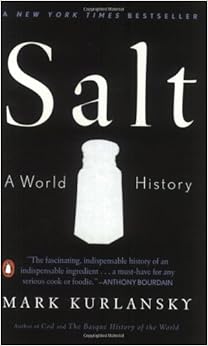
Book #4: Salt: A World History by Mark Kurlansky
Product Details:

- Paperback: 498 pages
- Publisher: Penguin Books (January 28, 2003)
- Language: English
- ISBN-10: 0142001619
- ISBN-13: 978-0142001615
Professional Review from the Library Journal: In his latest work, Kurlansky (Cod, The Basque History of the World) is in command of every facet of his topic, and he conveys his knowledge in a readable, easy style. Deftly leading readers around the world and across cultures and centuries, he takes an inexpensive, mundane item and shows how it has influenced and affected wars, cultures, governments, religions, societies, economies, cooking (there are a few recipes), and foods. In addition, he provides information on the chemistry, geology, mining, refining, and production of salt, again across cultures, continents, and time periods. The 26 chapters flow in chronological order, and the cast of characters includes fishermen, kings, Native Americans, and even Gandhi. An entertaining, informative read, this is highly recommended for all collections.
Customer Review from Amazon.com: As a global history, this book is an ambitious attempt to re-introduce us to something we think common and uninteresting. It's immensely successful through Kurlansky's multi-faceted approach. He combines economics, politics, culinary practices, tradition and myth in making his presentation. About the only aspect ignored is the detailed biological one explaining why this compound is so necessary to our existence.
This book is said to give a full account of the history of salt, including information from all aspects.
This book is said to give a full account of the history of salt, including information from all aspects.
Book #5: Pepper: A History of the World's Most Influential Spice by Marjorie Shaffer
Product Details:
Paperback: 320 pages

Paperback: 320 pages
- Publisher: St. Martin's Griffin; Reprint edition (August 5, 2014)
- Language: English
- ISBN-10: 1250048664
- ISBN-13: 978-1250048660
Professional Review from David Oshinsky, Pulitzer Prize-winning author of Polio: An American Story: “This is more than the story of a spice…Get ready for a sweeping ride through history."
Customer Review from Amazon.com: Schaffer has done a good job in giving us a history of pepper. She has researched thoroughly, yet maintained the story in history. One will come away from the book with a better understanding of both the spice and the way in which it shaped history. Schaffer gives enough information to satisfy your curiosity, but leaves enough unsaid to encourage further discovery. This seems to be what a good history book should do.
Based on the reviews, it seems that this book gives the reader a broad, all encompassing history of pepper.
Based on the reviews, it seems that this book gives the reader a broad, all encompassing history of pepper.

Thursday, September 4, 2014
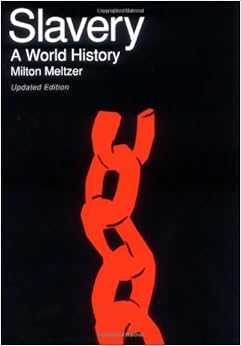
Book #6: Slavery: A World History by Milton Meltzer
Product Details:
Paperback: 608 pages

Paperback: 608 pages
- Publisher: Da Capo Press; Upd Rep Su edition (August 22, 1993)
- Language: English
- ISBN-10: 0306805367
- ISBN-13: 978-0306805363
Professional Review from the Library Journal: Though subtitled "A World History," this work pretty much confines itself to the ancient Near East, Greece, Rome, and the West. However, it does deal with Nazi and Soviet slavery and contemporary slavery in such places as Brazil and Thailand.
Customer Review from Amazon.com: A great book, scholarly but easy to read. Originally published in two volumes, the first half deals with slavery from ancient times to the Renaissance, the second half concentrates on the African slave trade, and also covers some of the modern uses of forced labor, gulags and other types of near-slavery. I particularly appreciated reading about slavery in earliest history, a topic that is rarely covered. The comprehensive nature of this book keeps slavery in perspective, but doesn't shy away from the worst abuses when people are classed as property.
This book teaches readers a history of silvery stretching back thousands of years as opposed to focussing on more recent examples.
This book teaches readers a history of silvery stretching back thousands of years as opposed to focussing on more recent examples.
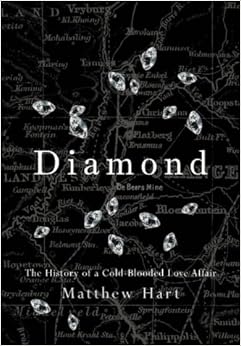
Book #7: Diamond: The History of a Cold-Blooded Love Affair by Matthew Hart
Product Details:
- Paperback: 288 pages
- Publisher: Plume (August 27, 2002)
- Language: English
- ISBN-10: 0452283701
- ISBN-13: 978-0452283701
Professional Review from the Library Journal: No other gem holds the allure and mystery of the diamond. In this book, journalist and author Hart (Golden Giant, 1985) offers a brief history of this supreme gem and the industry surrounding it. Part science text, part business history, part biography, and part travelog, the book provides some fascinating glimpses into the world of diamonds but can appear disjointed. Hart writes about South Africa's long-lived De Beers cartel and the attempts to unseat it, the unscrupulous characters of the trade, and the many aspects of the business, from miners to retailers. Taken separately, the anecdotes are interesting, even engaging, but throughout the book, the reader is left feeling that there is more to the story. A significant portion of the work covers the recent diamond finds in Canada, which Kevin Krajick's Barren Lands: An Epic Search for Diamonds in the North American Arctic (W. H. Freeman, 2001) covers in greater detailed study. Recommended for large business and business history collections. (Index not seen.) Mike Miller, Dallas P.L.
Costumer Review from Amazon.com: Hart lays out the basic foundation and history of diamond geology and its shrouded history. From yarns about hustlers and theives to the geological formations known as pipes, Hart imparts the beauty and dark side of the trade. And, as mentioned, Hart casts his line into the vast monopoly known as De Beers. He explains how De Beers has managed to control the flow of diamonds not only to the wholesale "site" markets but, more recently, to the retail market as well. We learn how the Oppenheimer family has ruled this industry with an iron fist and a deft touch. Further, and strangely to this reader, we learn the origins of the De Beers name...a totally unexpected twist.
This book combines all elements of the history of diamonds.

This book combines all elements of the history of diamonds.
Book #8: Hemp Horizons: The Comeback of the World's Most Promising Plant (Real Goods Solar Living Book) by John Roulac
Product Details:
Paperback: 226 pages
According to the reviews, this book not only gives the reader a complete history of hemp, but also serves to dispel the stigma surrounding it.

Paperback: 226 pages
- Publisher: Chelsea Green Publishing Company; 1st edition (September 1997)
- Language: English
- ISBN-10: 0930031938
- ISBN-13: 978-0930031930
Professional Review from the Library Journal: Hemp, a variety of the genus Cannabis, is a versatile crop used in the manufacture of twine, textiles, home furnishings, shoes, clothing, and construction materials. It grows rapidly, is adaptable to most climates, and improves soil fertility. Twenty-nine countries, including the major industrialized nations, are hemp producers. However, large-scale production is prohibited in the United States, owing to an erroneous belief that its leaves can be made into a marijuana-like drug. Roulac, president of HEMPTECH, a consulting company that promotes industrial hemp, provides an overview of the history, politics, global uses, markets, and farming practices for hemp. Arguing that the production, marketing, and manufacture of hemp and hemp products offer possibilities for new enterprises in the United States and competition in the world market, Roulac urges Americans to repeal the anachronistic law prohibiting hemp production. A well-documented book; recommended for agriculture and business collections.?Irwin Weintraub, Rutgers Univ. Lib., New Brunswick, N.J.
Customer Review from Amazon.com: This book is an eye opener for those who appreciate the potential for every thing old to be new again. It outlines a compelling case for re-examining the value of hemp
as an agricultural renewable resource. The book's tone is very "straight" and specifically eschews the
mixing advocacy of herb and fiber. Along with a thorough overview history of hemp use, cultivation, and current purposes, the book offers a product directory, strong bibliography, and access to its web site.
According to the reviews, this book not only gives the reader a complete history of hemp, but also serves to dispel the stigma surrounding it.

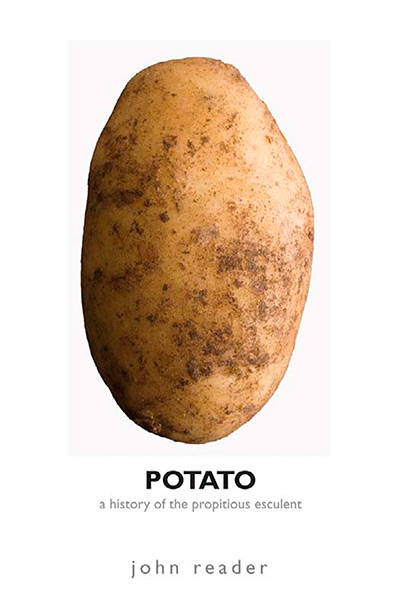
Book #9: Potato: A History of the Propitious Esculent by John Reader
- Hardcover: 336 pages
- Publisher: Yale University Press (March 17, 2009)
- Language: English
- ISBN-10: 0300141092
- ISBN-13: 978-0300141092
Professional Review from The New Yorker: This enjoyably meandering history looks at the potato as a plant of paradox. It has been revered as an aphrodisiac and feared as a cause of leprosy. Populations rise dramatically wherever it is introduced, but reliance on it “ensnares more people in poverty than it lifts out.” Reader traces the evolution of the potato from poisonous Andean weed to global staple, offering adept disquisitions on whatever captures his attention: the mysterious origins of agriculture, the economic history of Peru, the domestic arrangements of the Irish. There are glimpses of the Reign of Terror, when the ornamental gardens of the Tuileries Palace were planted with potatoes, and the Great Potato Boom of 1903 and 1904, when an investment bubble grew as a result of false claims made for a potato strain known as Eldorado. This is a story of invisible systems and unintended consequences, concerned with how the New World transformed the Old.
Copyright ©2008 Click here to subscribe to The New Yorker
Customer Review from Amazon.com: Before I read this book, I knew that potatoes came from South America, that the Spanish brought them to the new world, that there was an Irish potato famine that drove many Irish to emigrate to America, and that french fries and potato chips aren't the healthiest foods. I have grown potatoes in my garden, so I know that there are different varieties to choose
from, different sizes, shapes, colors, cooking qualities, tastes, and ripening times, and that one should
not plant them in the same place repeatedly, although I've never had a problem, and they come up in
the same place on their own the next year anyway. I knew about the role M. Parmentier played in popularizing the potato in France, and about the French potato dishes that bear his name today. But as for all the rest of the history of the potato...I had absolutely no idea. I found this book absolutely fascinating. We so take the potato for granted, that big bulging brown thing that we bake or mash or fry, or the red "new potato" that we boil and use for more delicate purposes. (The French have access to and enjoy a much wider range of nuanced varieties.) I did not realize the impact the potato has had
on various societies, its importance all over the world, its development as a useful, modern crop, and
the huge volume of potatoes grown today. I had no idea that the Chinese grew potatoes, as potatoes don't appear on Chinese restaurant menus. I had no idea of the extensive efforts to breed useful varieties, and to find solutions to the late blight that caused the Irish famine. I had never thought about wild potatoes and their characteristics. The more one learns about something, the more interesting it becomes. This book has given me tremendous respect for the potato and for all of the people that have contributed to making it the tuber we know and love today. Super book.
This book appears to highlight the Importance of the potato in shaping certain historical events.
on various societies, its importance all over the world, its development as a useful, modern crop, and
the huge volume of potatoes grown today. I had no idea that the Chinese grew potatoes, as potatoes don't appear on Chinese restaurant menus. I had no idea of the extensive efforts to breed useful varieties, and to find solutions to the late blight that caused the Irish famine. I had never thought about wild potatoes and their characteristics. The more one learns about something, the more interesting it becomes. This book has given me tremendous respect for the potato and for all of the people that have contributed to making it the tuber we know and love today. Super book.
This book appears to highlight the Importance of the potato in shaping certain historical events.
Book #10: Coal: A Human History by Barbara Freese
Coal: A Human History
Product Details
Product Details
- Paperback: 320 pages
- Publisher: Penguin Books (January 27, 2004)
- Language: English
- ISBN-10: 0142000981
- ISBN-13: 978-0142000984
Professional Review from Publisher Weekly:
Coal has been both lauded for its efficiency as a heating fuel and maligned for the lung-wrenching black smoke it gives off. In her first book, Freese, an assistant attorney general of Minnesota (where she helps enforce environmental laws), offers an exquisite chronicle of the rise and fall of this bituminous black mineral. Both the Romans and the Chinese used coal ornamentally long before they discovered its flammable properties. Once its use as a heating source was discovered in early Roman Britain, coal replaced wood as Britain's primary energy source. The jet-black mineral spurred the Industrial Revolution and inspired the invention of the steam engine and the railway. Freese narrates the discovery of coal in the colonies, the development of the first U.S. coal town, Pittsburgh, and the history of coal in China. Despite its allure as a cheap and warm energy source, coal carries a high environmental cost. Burning it produces sulfur dioxide and carbon dioxide in such quantities that, during the Clinton administration, the EPA targeted coal-burning power plants as the single worst air polluters. Using EPA studies, Freese shows that coal emissions kill about 30,000 people a year, causing nearly as many deaths as traffic accidents and more than homicides and AIDS. The author
contends that alternate energy sources must be found to ensure a healthier environment for future
contends that alternate energy sources must be found to ensure a healthier environment for future
generations. Part history and part environmental argument, Freese's elegant book teaches an important lesson about the interdependence of humans and their natural environment both for good and ill throughout history.
Customer Review from Amazon.com:
Freese's book is an excellent and engaging history of the history of coal and its relationship to the
history of three nations: The United Kingdom, the United States, and China. She writes exceptionally fluidly, with, at once, broad sweeps and minute details that keep you both interetsed and informed. She also has a lovely dry sense of humor. Her chapter on Manchester, by the way, is excellent.
The book isn't academic (to her credit), but nor is it a vapid popular account. Instead, Freese has written a book that does the nearly impossible in that it is well-researched, historically accurate,
engaging almost, but not, to the point of being chatty. I couldn't put it down. What it lacks, by way of
an academic angle, is a discussion of what else had been written in the past about the history of coal, as well as a theoretical approach. This is hardly a criticism because that really isn't the intention of this book. In fact, believe the book would have suffered had she taken this approach.
I agree with another reviewer who suggested that Freese didn't know how to end the book--although I did find her discussion of alternatives to coal to be compelling. There are two typos in the book that evaded the copy editor, but otherwise this book is a small masterpiece. You will enjoy it.
In reading this book, the reader not only gets a complete history of coal, but also information and statistics concerning coal's impact on the environment.

The book isn't academic (to her credit), but nor is it a vapid popular account. Instead, Freese has written a book that does the nearly impossible in that it is well-researched, historically accurate,
engaging almost, but not, to the point of being chatty. I couldn't put it down. What it lacks, by way of
an academic angle, is a discussion of what else had been written in the past about the history of coal, as well as a theoretical approach. This is hardly a criticism because that really isn't the intention of this book. In fact, believe the book would have suffered had she taken this approach.
I agree with another reviewer who suggested that Freese didn't know how to end the book--although I did find her discussion of alternatives to coal to be compelling. There are two typos in the book that evaded the copy editor, but otherwise this book is a small masterpiece. You will enjoy it.
In reading this book, the reader not only gets a complete history of coal, but also information and statistics concerning coal's impact on the environment.

Subscribe to:
Posts (Atom)